
Across Hawaiʻi, American Samoa, Guam and the Mariana Islands, communities are confronting a growing set of external pressures, including climate change, biodiversity loss, increasing visitor impacts on public lands and the urgent need to preserve cultural knowledge. At the same time, federal and state land management agencies face a workforce challenge.
Through our specialized conservation workforce development programming across the Pacific, we are empowering local youth to protect the natural world in their communities, ensuring that those who are directly affected by environmental impacts are the very ones leading the charge to mitigate them, especially in places where cultural and ecological stewardship have been practiced for generations.
Central to the success of this model is our commitment to recruit locally. Doing so goes beyond youth engagement to develop a locally grounded conservation workforce pipeline that strengthens ecosystems and supports communities while building the next generation of conservation leaders.
Our crew members support a wide range of critical environmental and natural resource priorities. Depending on the unique needs of their home islands, they serve in visitor services and interpretation, endangered species protection, native plant propagation, wildlife management, trail building and maintenance, marine ecology and more.
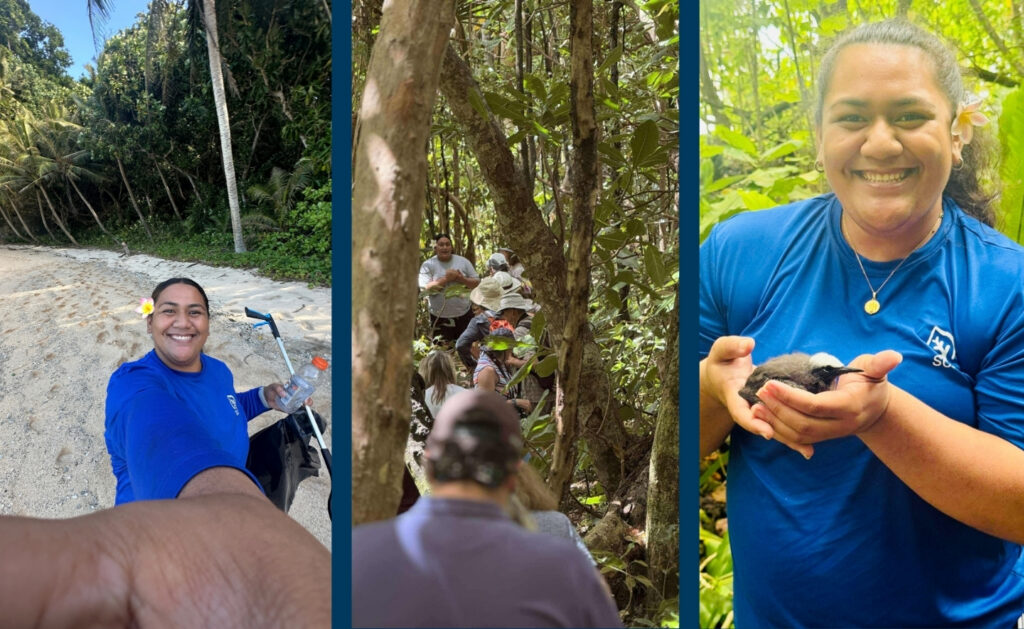
SCA crew member Ariel Fa’ali’i at work in American Samoa National Park. (Photo credit: Ariel Fa’ali’i)
At the National Park of American Samoa, Ariel Fa’ali’i spent the last two years with the SCA working as an Interpretive Park Ranger Intern, translating for park visitors, coordinating volunteer events, leading guided hikes and interpretive talks, delivering educational programs and collecting data alongside the marine team.
“I am very grateful to be a part of the SCA. I am an introvert, and since stepping into this role, it’s really helped open opportunities for me and get me out of my comfort zone,” said Fa’ali’i. “I grew up on this island. I love this place, and I haven’t had a chance to be as connected to the island as I am now. We can take it for granted, and I just want to share my passion and love for the island because that’s who I am.”
Prior to working at the park, Fa’ali’i earned an associate’s degree in automotive technology and civil engineering from the American Samoa Community College. While working as a civil engineer for the local power utility’s water department, Fa’ali’i said she had a different calling and applied for a rare, coveted opening at the park. What came next not only allowed Fa’ali’i to help her parents but also became the experience of a lifetime.
“I didn’t think I was ever going to be certified as a scuba diver. And I didn’t think I was going to travel to the other national park islands here in American Samoa. I am very passionate about the outdoors,” Fa’ali’i said. “The work is very important because we’re on a tiny island and marine debris, rising ocean levels, and global warming have a large impact. Educating visitors, especially the kids here, about these effects will help us in the future.”
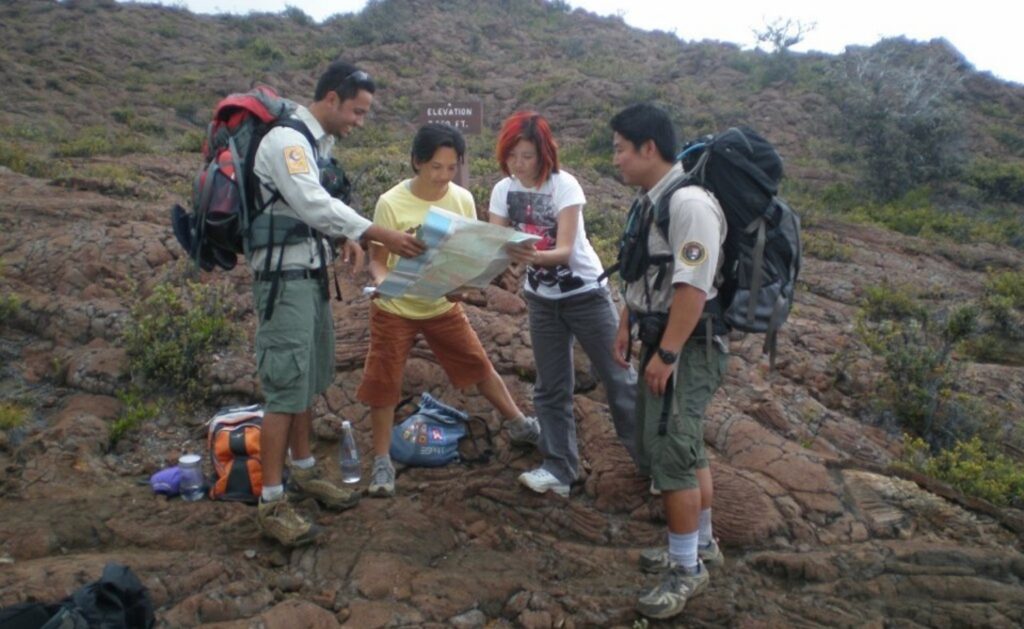
Hawaiʻi Volcanoes National Park Chief Ranger Nainoa Keanaʻaina (pictured far left) with Ranger Adam Kojima assisting park visitors. (Pfoto credit: Nainoa Keanaʻaina)
In Hawaii, stewardship is deeply connected to ʻāina, a Native Hawaiian understanding that the land nourishes, sustains and connects communities across generations. For nearly two decades, the SCA has been continuously fielding dedicated young people at Haleakalā National Park on Maui and Hawaiʻi Volcanoes National Park on the Island of Hawaiʻi, providing a stable pipeline for green careers within the National Park Service.
A pipeline that paved the way for Nainoa Keanaʻaina to fulfill his dream of becoming a park ranger at Hawaiʻi Volcanoes National Park. Nainoa served with the SCA in 2007 and 2008 as a Backcountry Intern at Hawai’i Volcanoes National Park while he was in college. After graduating, he was hired at the park as a Ranger and was recently promoted to Chief Ranger, where he oversees and mentors current SCA crew members.
The same SCA backcountry team that got him his start continues to provide wilderness stewardship, visitor safety, biodiversity protection and educate the public during high-volume volcanic activity. Under his leadership, SCA crew members worked alongside park staff to protect endangered species, manage remote backcountry infrastructure and engage thousands of visitors in responsible recreation practices.
SCA backcountry crew member Kaʻimi Kealoha served as a vital local presence in remote volcanic zones. While managing crowds during active geological events and promoting Leave No Trace ethics, Kaʻimi undertook a specialized mapping project to accurately document backcountry signs, collaborating with Native Hawaiian cultural experts to ensure visitor safety materials remained accurate and respectful of cultural boundaries. For Kaʻimi, the work transcended typical trail maintenance and transformed into an act of cultural continuity.
“While working in the remote forests, I felt a deep connection to my kūpuna ancestors,” Kaʻimi said. “I started to understand more about how they lived with the land, not just on it. It wasn’t just about doing trail work anymore, it became about respecting and continuing something much bigger than myself.”
The National Park of American Samoa is the only National Park Service site south of the Equator and is the last place on earth to see the sun set. The park has sites on the tropical islands of Tutuila, Ta’ū and Ofu and is home to expansive tropical rainforests on steep volcanic mountain slopes, surrounded by coral reefs. In keeping with the meaning of the word Samoa (sacred earth), park staff helps protect fa’a Samoa, the customs, beliefs and traditions of the 3,000-year-old Samoan culture.
Crews are ready. Projects are waiting. But we can’t keep programs running without your support. Turn your love for the outdoors into action.

Protect What You Love widget on website
"*" indicates required fields